SSV Network is the largest DVT staking protocol on Ethereum that makes staking more secure by distributing validator operations across multiple independent nodes.
SSV Network is transforming how validators operate on Ethereum. This guide covers everything you need to understand about ssv staking, the SSV token, and distributed validator technology.
What Is SSV Network? (ssv network, ssv crypto, SSV)
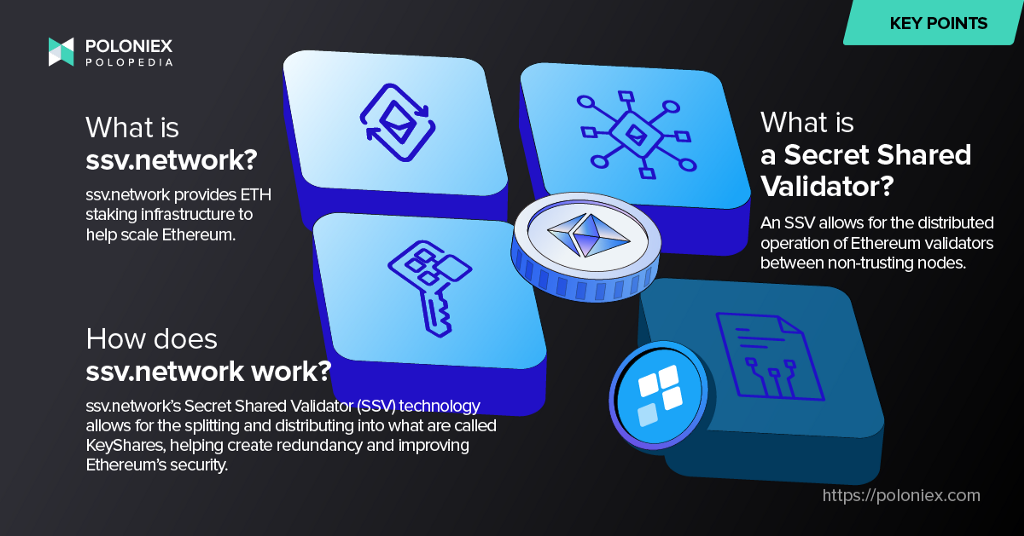
SSV Network is a decentralized Distributed Validator Technology (DVT) protocol designed to make Ethereum staking more secure and resilient. Built as a permissionless, open-source, and trustless infrastructure layer, it splits an Ethereum validator key across multiple operators.
The SSV token-often called ssv crypto-serves as the network's native utility asset. Stakers use it to pay operators for their services, while holders can vote in SSV DAO governance decisions. Token holders participate in voting on protocol upgrades, treasury allocations, and network fees via the SSV Network DAO. Notably, the DAO approved DIP-56, a 2-year agreement with Sigma Prime to continue developing Anchor, the second SSV client.
Research originated with the Ethereum Foundation in 2019-2020, followed by testnet phases through 2021-2023 and mainnet launch in early 2024. Whether you see it written as ssv network, ssv.network, s s v, or s.s.v, all refer to the same DVT staking protocol now securing over 7.4 million ETH, with a total value locked (TVL) of $17.2 billion and approximately 19% of Ethereum validators running on the SSV network.
How SSV DVT Works (Distributed Validator Technology, ssv dvt, S S V)
SSV DVT splits a single Ethereum validator key into KeyShares distributed across independent operators. Using threshold signature mechanisms and Shamir's Secret Sharing, the validator key is split into KeyShares that can be generated and stored securely offline, with only encrypted KeyShares residing on active nodes. This design ensures no single operator ever holds the complete key or has unilateral control, significantly reducing the risk of slashing.
The process works simply:
- One private key splits into multiple KeyShares
- Each KeyShare is run by a different operator
- A threshold (typically 3 of 4) must cooperate to produce blocks
Traditional solo validators represent a single point of failure-one compromised machine means total loss. Validators on ssv dvt run across multiple operators, ensuring that if one goes offline, others continue work seamlessly. The QBFT consensus mechanism can handle one faulty node in a four-operator setup, delivering true active-active fault tolerance. Active-active redundancy and fault-tolerant design enable SSV clusters to achieve 98-99% effectiveness in keeping validators online, maximizing rewards.
Why Use SSV for Ethereum Staking? (ssv staking, ssv stake, stake ssv)
SSV staking improves security, decentralization, and performance for Ethereum validators.
Key benefits include:
- Security: No single entity holds your complete validator key; private keys can be generated and stored offline to enhance safety.
- Decentralization: Choose operators across different geographies and clients, supporting a distributed validator infrastructure that minimizes operational and counterparty risk.
- Performance: Higher uptime through fault-tolerant design and active-active redundancy, reducing slashing risk and downtime.
Institutions use SSV to meet compliance requirements while maintaining Ethereum's trustless architecture. Individuals with 32 ETH can use SSV to improve their uptime and security without needing 24/7 hardware maintenance. Liquid staking protocols can also integrate SSV to decentralize their node operator sets further and improve fault tolerance. When you stake ssv-style, your validators keep running even if some operators experience downtime.
How to Stake on SSV Network (Step-by-Step ssv staking Guide)
To stake on ssv network:
- Acquire 32+ ETH and prepare your validator key
- Select SSV operators from the supported network
- Configure KeyShares via an SSV-compatible wallet or application
- Activate your validator on mainnet
Many staking services integrate SSV infrastructure, making the process nearly one-click. Stakers pay operators fees in SSV tokens based on uptime and performance. Diversify your operator set across different providers to maximize your ssv stake yield.
SSV Token & Economics (ssv crypto, SSV Token Utility)
The SSV token powers the ssv.network protocol with approximately 11 million tokens in circulation. Primary utility includes paying operator fees and participating in DAO governance. Participants use the native SSV token to vote on protocol updates, treasury allocations, and operator fees. Operators charge fees they determine, creating competitive services. Those delivering strong performance earn more; poor uptime results in lower earnings. SSV is an ERC-20 token traded on major exchanges.
This content does not constitute financial advice. Research ssv crypto risks before investing.
SSV Network Ecosystem, Governance & Roadmap (ssv network Future)
The SSV DAO governs protocol upgrades, grants, and ecosystem development through token-based voting. The roadmap lays out the road ahead, focusing on supporting more SSV clients, improving operator tooling, and expanding MEV-relay setups.
The strategic goal: make ssv network the default DVT layer for Ethereum, ensuring resilient staking at scale for both retail and institutional users. The SSV network stands out for its reliability and confidence in its roadmap and future direction.
Ready to learn more? Explore SSV documentation, join DAO forums, or follow governance proposals to shape the network's future.